XU BEIHONG (1895-1953)
$500
XU BEIHONG (1895-1953)
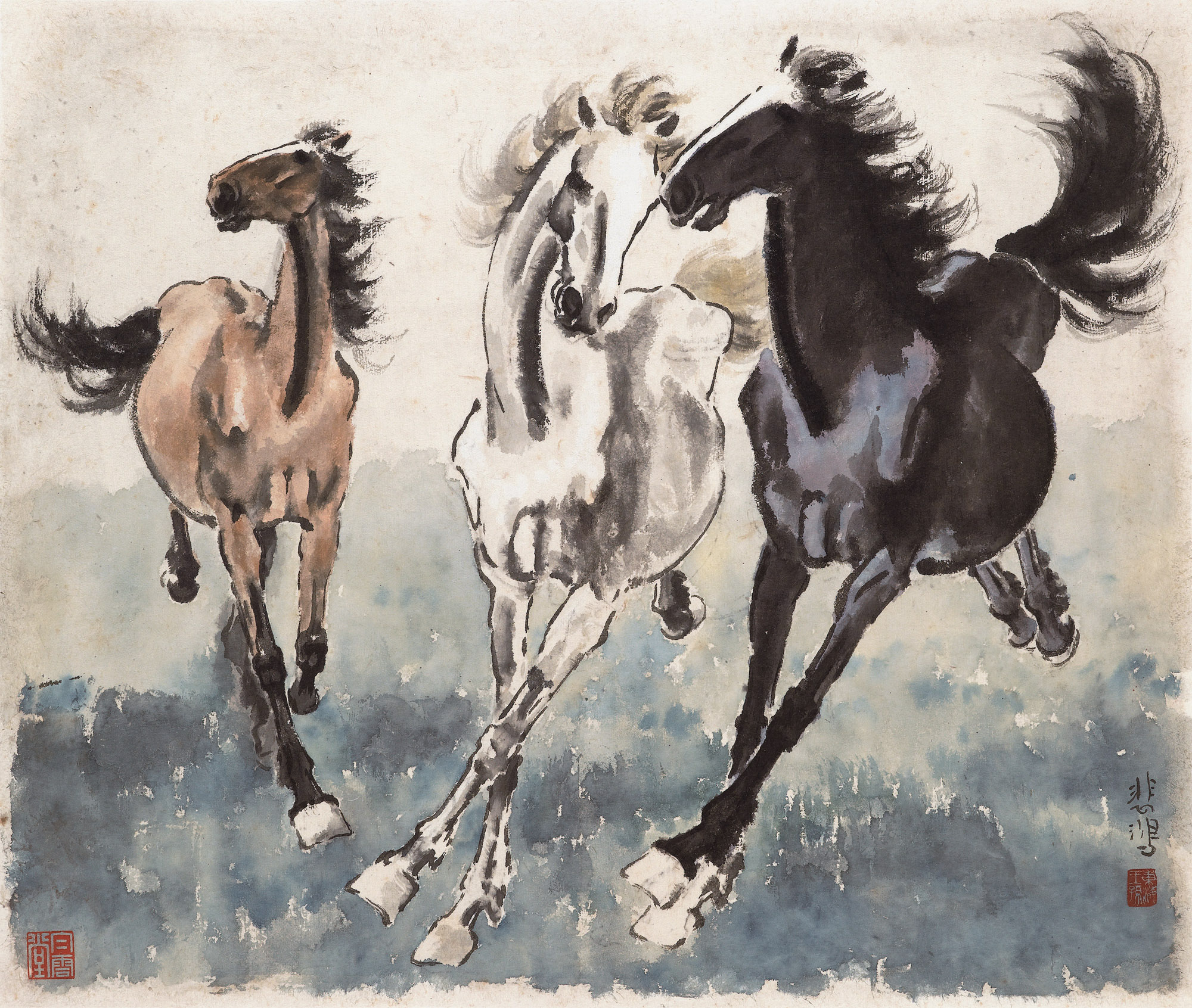
The Three Stallions
Scroll, mounted and framed, ink and colour on paper
56.5 x 67 cm. (22 1/4 x 26 3/8 in.)
Signed, with one seal of the artist
One collector's seal of Hung Junbi (1898-1991)
Note:
There are three reasons as to why this painting is exceptional.
Firstly it is a watercolour creation by a prominent ink painter; secondly, its subject matter, three running horses, is rare; thirds, it was previously in the collection of the well known artist Huang Junbi (1898-1991).
Xu's earlier watercolours were characterized by a fusion of traditional ink painting skill fused with the natural elements and effects of watercolours. Educated in the West in sketching and oil painting, realism was a key and basic element that Xu had to master in the early stages of his career. Presented to Cai Yuanpei and Ji Juemi in 1918 and 1919 respectively, the composition of three running horses exemplifies Xu's education in Western perspective and use of colour. Xu once wrote in an essay: "Chinese painting raw materials are slightly inferior to Western onesKChinese raw paper makes it difficult for the pigments to be absorbedKThe original colours are less able to correctly reflect natural pigments and true colours, on occasion rendering the painting flat and uninspiringKpainters must never just copy from old masters but should paint from nature and their surroundings to achieve realism, a beauty in art." Watercolour paper, with its better absorption, assisted Xu in achieving that beauty.
The Three Stallions, using watercolour paper, uses the 'wetness' to bring out the lush grass and the energy of the horses, as well as the infinite background that adds depth and perception to the painting. Similar to his previous compositions, The Three Stallions consist of a black horse, a white horse and a young mare, leisurely galloping through a pasture . Although this piece is undated, it is believed that it was created around 1930, as Xu's eldest son by Jiang Biwei, Xu Boyang was born in 1927. At a time of great joy and the beginning of commercial success, it is not surprising that the composition presents a family of three basking under the sun, free and happy.
The collector's seal Bai Yun Tang comes from Huang Junbi. Huang Junbi, Xu Beihong and Zhang Daqian rose to prominence around the same time and were good friends- Xu took a trip to visit Huang during his time at the Guangzhou Art Institute in 1927. Huang Junbi was also a well-known collector, evidenced by the inscription by Xu on a portrait he painted of Huang in 1938. In the winter of 1944, Xu dedicated Rooster to Huang as a sign of their friendship.
There is an added fourth element to the rarity of this painting, that is the mood and atmosphere in which it was painted. Removed from the burdens of war, family troubles and the pressures of stardom, this work painted at the beginning of his career reflects a man of energy, enthusiasm and ambition, so that viewers feel a sense of harmony and warmth in the painting.