Composition
$500
ARSHILE GORKY (1904-1948)
Composition
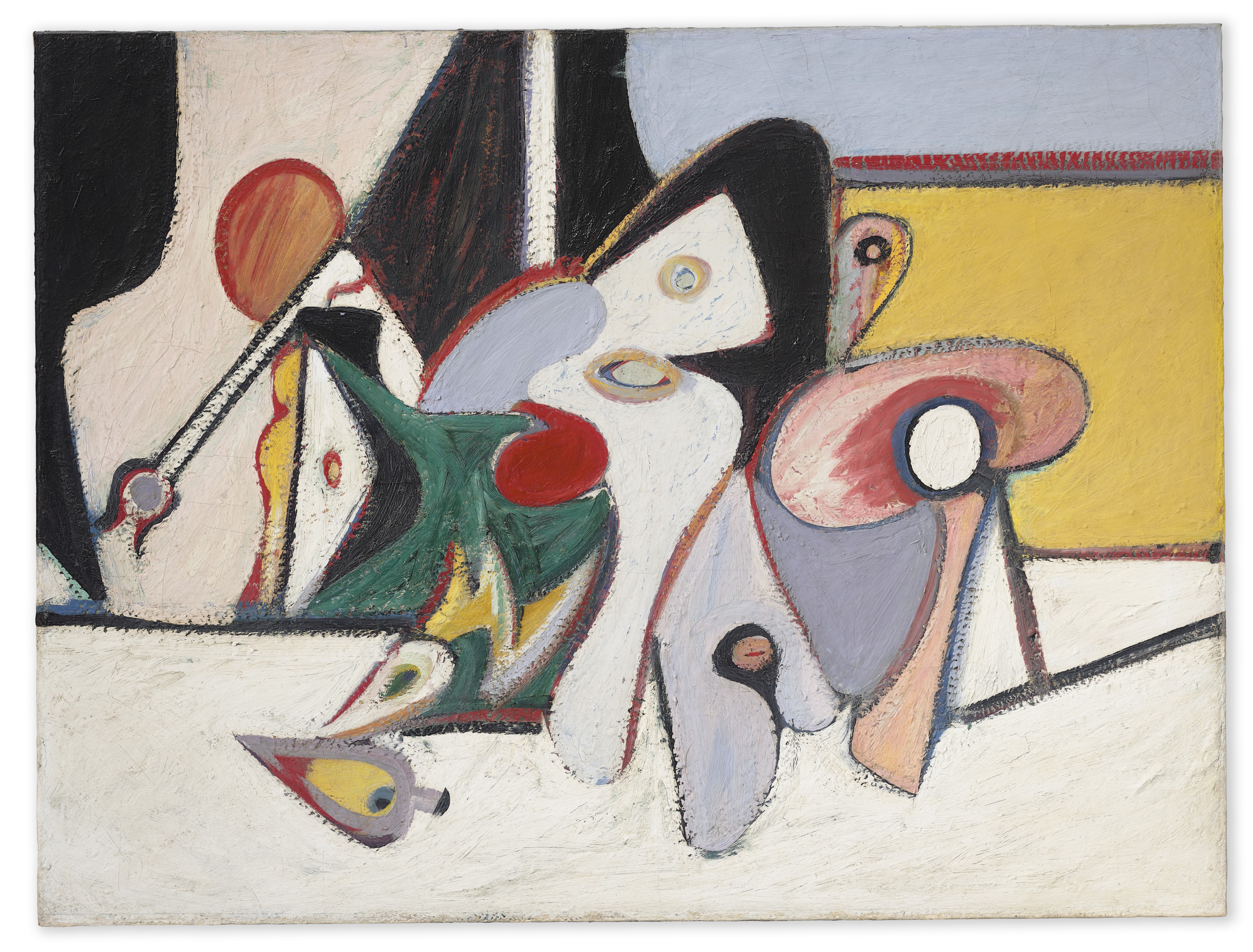
Painted between 1936 and 1937, Composition is an important, early painting from the formative years of Arshile Gorky’s artistic career. It belongs to the crucial body of work in which he establishes many of the key pictorial motifs that will go on to form so much of the celebrated Garden of Sochi series just a few years later (1940-1942). His densely painted surface is at its utmost thickness at this time, as the artist begins to unearth the enigmatic forms that will resonate with his troubled personal history and dreams of his native home, near the shores of Lake Van in Armenia.
Gorky created a companion canvas, which he titled simply Painting, during the same period and this was acquired by the Whitney Museum of American Art in 1937, making it the first of Gorky’s works to enter a museum collection. In Composition and the nearly identical sister work at the Whitney, Gorky extrapolates on many of the formal elements of the earlier series of Khorkom paintings that he created in 1936, whilst looking forward to Garden in Sochi (1940-42). In Composition, Gorky creates an fascinating inner world, where the brightly-colored biomorphic forms call to mind birds, leaves, foliage and—increasingly as the years went on—the sights and sounds of his native Armenia. In Composition, Gorky arranges the figures in a centralized group, placed upon a white table-top with a distant view of a window in the far left. Familiar forms begin to emerge, including two standing bird figures, depicted in profile, that regard each other in the middle of the canvas. Several round orbs are delineated throughout the painting—evoking eyes, mouths or other body parts. Toward the lower edge are two spade-like shapes resembling peacock feathers, arrow-heads or even garden trowels. The vibrant palette evokes so much of Gorky’s Armenian summers in the fields, especially the “Armenian red,” pink, deep green and a kind of “cantaloupe” yellow. Everything is fixed into place in a kind of interlocking puzzle arrangement.
A deeply tragic yet utterly brilliant artist, Gorky had by this time settled into his artist’s life in New York. He received a stipend from the Federal Arts Project for a mural commissioned for Newark Airport that was largely influenced by Fernand Léger. Increasingly at this time, he was painting still lifes populated with enigmatic forms clustered together in the center of the canvas. He painted these in his studio off East 16th Street near Union Square. Gorky may have been enjoying the simple pleasures of domestic life, as his sister Vartoosh and her toddler son had been living with him around this time.
In Gorky’s universe, however, nothing is ever as it seems. As soon as one form snaps into being, it loses recognition and sinks back into being an abstract shape. In Composition, what first appears to be a still life arranged upon a table-top seems to open up onto a sense of deep recessional space, almost like a stage-set or landscape. The shapes become more fully rounded and three-dimensional, evocative of landscape though never fully committing to it. Instead, the surrealist forms break free to straddle the realm of dreams and memories. As the Museum of Modern Art curator William C. Seitz has written, “This theme is pure Gorky, an artist for whom the vital task (to use the words of the painter Adolph Gottlieb) was a wedding of abstraction and surrealism" (W. Seitz, Arshile Gorky: Paintings, Drawings, Studies, exh. cat., Museum of Modern Art, New York, 1963, p. 20)."
As a young artist living in New York, Gorky admired Picasso’s paintings of 1926-28, such as Painter and His Model (1928). He adapts these Cubist devices in Composition, in the flattened planes of color and the reliance on thick black outlines. He also invokes the surrealist-derived biomorphic iconography of Joan Miró. “Gorky went farther than Picasso in the direction of biomorphic abstraction,” Seitz again explained, “which he must have seen also in the work of Arp, Miró, and others. [...] Almost no reference is made to objects, so emotional content is free to become the subject” (W. Seitz, Ibid., p. 20)
Together with the Khorkom paintings of 1936, these influences have been brought to full flourish in Composition. Given the artist’s scant resources, he primarily focused on drawings because paper was so much cheaper than buying oil paints and canvas. Thus, Composition was a rather large, demonstrative painting for the time—a bold, courageous act for the artist. In 1951, Composition was also one of only two paintings to be selected for the Museum of Modern Art’s major watershed exhibition that effectively shifted the center of the art world from Paris to New York. Called “Abstract Painting and Sculpture in America,” this large and important survey included many of the most important Abstract Expressionist artists including Jackson Pollock, Mark Rothko and Robert Motherwell. There, Gorky’s Composition was installed next to Agony (1947), now in the Museum of Modern Art, New York.
Shortly after it was painted, Composition was purchased by one of Gorky’s greatest champions and supporters, Isobel Grossman and her husband, I. Donald Grossman. Donald was Sidney Janis's brother-in-law through his wife, Harriet (“Hansi”) Grossman. It was Isobel who was determined to support the artist during the meager years of the latter 30s. In 1938, she and her husband walked over to Gorky’s studio near Union Square from their apartment overlooking Gramercy Park, where they purchased three of Gorky’s paintings, including the present work, Composition of 1936-37. That sale provided much needed funds to the struggling artist, who was largely subsisting on WPA stipends at the time. Several decades later, Isobel Grossman helped to organize a major touring retrospective of Gorky’s work— Arshile Gorky: Drawings to Paintings of 1976—which included the present Composition.
“Abstraction allows man to see with his mind what he cannot physically see with his eyes... Abstract art enables the artist to perceive beyond the tangible, to extract the infinite out of the finite. It is the emancipation of the mind. It is an explosion into unknown areas.” Arshile Gorky
Arshile Gorky, tragic figure and creator of the beautifully enigmatic paintings and drawings for which he is best known, continues to be hailed as one of the 20th Century’s most beloved artists. In fact, many consider Gorky to be the grandfather of Abstract Expressionism. In Composition and so many of these paintings of the latter ‘30s, the viewer bears witness to the artist’s continuing evolution. Riddled with enigmatic and biomorphic forms, his paintings continue to resonate, invoking the deeply poignant memories of his tragic exile from Armenia in 1919.
oil on canvas
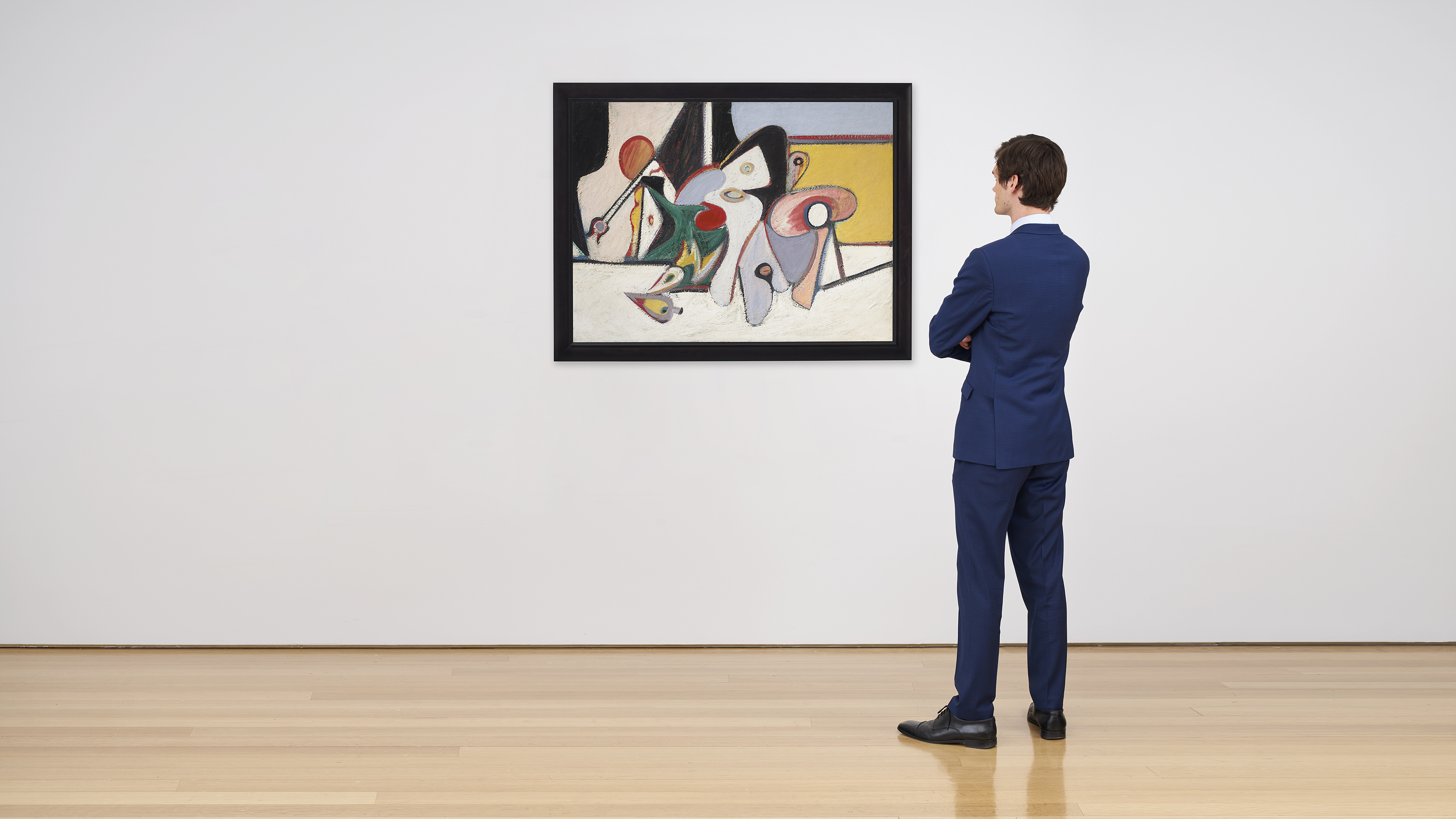
36 1/8 x 48 1/8 in. (91.8 x 122.2 cm.)
Painted in 1936-1937.